Product research is one of the most important decisions an Amazon seller makes.
Choose the right product, and you can build a profitable business around growing demand. Choose the wrong product, and you may end up with expensive inventory, intense competition, low margins, and slow sales.
The challenge is that Amazon sellers have access to enormous amounts of data—but turning that data into useful business decisions can take time.
This is where Helium 10 MCP can make a difference.
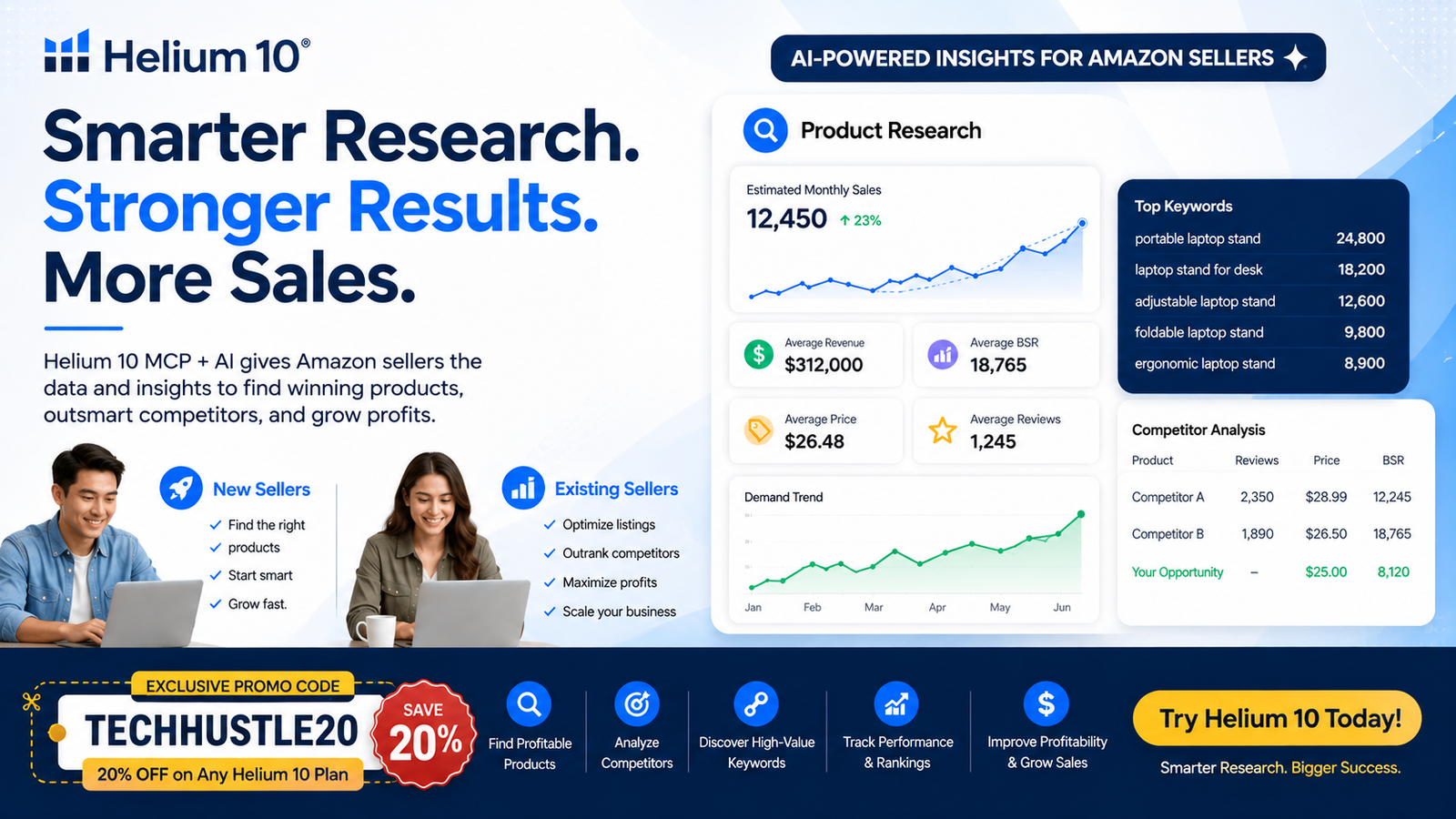
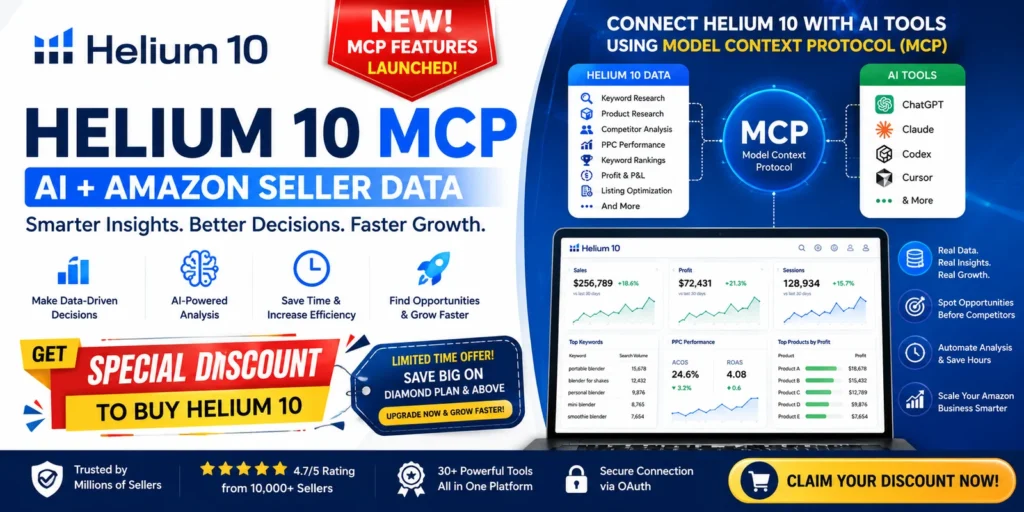
Helium 10 MCP connects Helium 10’s Amazon seller data with AI assistants such as ChatGPT, Claude, and Codex. Instead of repeatedly switching between research tools, exporting information, and manually analyzing spreadsheets, sellers can ask questions in natural language and receive analysis based on their Helium 10 data.
In this guide, we’ll explain what Helium 10 MCP is, how it can help with product research, how sellers can identify promising opportunities, and how both new and established Amazon businesses can use it to make better decisions.
What Is Helium 10 MCP?
MCP stands for Model Context Protocol.
In simple terms, it acts as a bridge between AI tools and external data sources.
For Amazon sellers, Helium 10 MCP allows an AI assistant to access relevant Helium 10 data and use it to answer research and business questions.
Instead of:
Open Helium 10 → Find the right tool → Research data → Export information → Analyze data → Make a decision
the workflow becomes:
Connect Helium 10 MCP → Ask your question → Retrieve relevant data → Let AI analyze it → Make a more informed decision
According to Helium 10’s documentation, MCP uses OAuth 2.0 authentication, meaning the AI does not receive your Helium 10 login credentials.
Why does this matter?
Because Amazon sellers don’t simply need data.
They need to understand what the data means and what action they should take next.
How Helium 10 MCP Can Help With Amazon Product Research
Product research is more than finding products with high sales.
A potentially attractive Amazon opportunity should be evaluated from multiple angles:
- Demand
- Competition
- Reviews
- Pricing
- Revenue potential
- Profitability
- Keywords
- Listing quality
- Competitor strength
- Market trends
- Seasonality
Helium 10 MCP brings several of these research capabilities together so sellers can investigate opportunities through natural-language questions.
Helium 10 documents product research tools that can search active products using filters such as category, price, BSR, reviews, revenue, and profit margin. It can also analyze niches, identify competitors, compare listings, and check live product information.

⭐⭐⭐⭐⭐
Step 1: Start With a Product Idea
You don’t always need to start with a specific ASIN.
You can begin with a category, keyword, customer problem, or product concept.
For example:
“Find potential opportunities in the home organization category with strong demand, manageable competition, and reasonable pricing.”
The objective isn’t to immediately select the first product that appears.
Instead, create a shortlist of potential opportunities.
Think of MCP as a research assistant that helps you move from a broad idea to a more focused set of products worth investigating.
Step 2: Analyze Market Demand
A product can look attractive but still have insufficient demand.
That is why demand validation should come before ordering inventory.
Helium 10 provides product research data that can help sellers evaluate sales, revenue, BSR, pricing, reviews, and competitive conditions. Its product research platform is designed to help sellers find products that have market demand and potential room for growth.
With MCP, an Amazon seller can ask questions such as:
“Which products in this category have strong estimated sales but relatively low review counts?”
Or:
“Show me products in this niche that meet my target price and sales requirements.”
This can dramatically reduce the amount of manual research required.
Step 3: Look for Products With a Better Competition Profile
High sales alone don’t necessarily mean a product is a good opportunity.
A product generating significant revenue may already be dominated by established brands with thousands of reviews.
The better question is:
Is there enough demand for a new seller to compete?
Helium 10 MCP can help identify competitors and compare products based on metrics such as rankings, reviews, pricing, and category positioning.
You can investigate questions like:
“Who are the main competitors for this ASIN?”
“Compare these three competing products.”
“Which competitors have strong sales but weaker listings?”
This shifts product research from simply finding popular products to finding opportunities within popular markets.
Step 4: Discover Emerging and Trending Opportunities
One of the biggest goals of product research is to identify demand before a market becomes overcrowded.
Helium 10’s keyword and product research capabilities can help sellers investigate changing demand.
Its keyword research tools include search-volume history, allowing sellers to examine how keyword demand changes over time and identify seasonal or emerging patterns.
Helium 10 also provides a Trending Products tool that shows top sellers across Amazon categories and uses trend indicators to help identify products moving up or down in popularity.
This can help sellers ask better questions:
“Which products are gaining momentum?”
“Which keywords have increasing search activity?”
“Is this demand seasonal or consistent?”
“Are sales increasing or declining?”
Important distinction
A product being “trending” does not automatically mean it will be profitable.
A trend should be validated against:
Demand + Competition + Price + Costs + Reviews + Keywords + Differentiation
That is where deeper product research becomes valuable.

Step 5: Analyze the Niche Before Entering It
Finding a product is only part of the process.
You also need to understand the market surrounding that product.
Helium 10 MCP can analyze a niche using a keyword and provide information such as market size, competition level, average price, and review density.
For example:
“Analyze the niche for ‘portable laptop stand’ and tell me whether the market appears attractive for a new private-label seller.”
You can then investigate:
- How large is the market?
- What price points dominate?
- How many established competitors exist?
- How many reviews do leading products have?
- Are there gaps in the market?
- What customer needs are competitors not addressing?
This provides a much broader picture than evaluating a single ASIN.
Step 6: Research Competitor Keywords
Finding a good product is not enough.
Customers must also be able to find it.
Keyword research helps sellers understand how shoppers search for products on Amazon.
Helium 10 MCP can retrieve keywords associated with ASINs, compare competitor keyword strategies, analyze search-volume history, and identify keyword opportunities.
For example, you could ask:
“Compare the keyword strategies of the top three competitors in this niche.”
This can reveal:
- High-value keywords
- Long-tail opportunities
- Competitor keyword gaps
- Keywords your competitors rank for
- Potential PPC targets
- Search trends
That information can then influence both product positioning and listing optimization.
Step 7: Analyze Competitor Listings
A product may have strong demand, but competitors may have weak listings.
That can create an opportunity.
Helium 10 MCP can retrieve listing details and analyze elements such as titles, bullet points, descriptions, images, pricing, reviews, BSR, and other listing information. It can also compare multiple listings side by side.
Ask:
“Compare the top three listings in this niche and identify their weaknesses.”
You may discover opportunities such as:
- Poor product images
- Weak bullet points
- Missing features
- Limited keyword coverage
- Unclear value proposition
- Poor differentiation
- Repeated customer complaints
Instead of copying competitors, use this information to identify how your product could be better.

Step 8: Use Customer Reviews as Product Research Data
Reviews can tell you what customers actually like and dislike about products.
Instead of reading hundreds of reviews manually, sellers can use AI-assisted analysis to identify recurring themes and competitive weaknesses.
For example:
“Analyze the reviews of the leading products and identify the five most common customer complaints.”
Then:
“Which of these complaints could be solved through product improvement?”
This creates an important connection between:
Product Research → Customer Feedback → Product Development → Differentiation
That can be especially valuable for private-label sellers.
Step 9: Validate Profitability Before Investing
Revenue isn’t profit.
A product generating $50,000 per month may still be unattractive if the seller has high:
- Product costs
- Amazon fees
- Advertising costs
- Shipping costs
- Returns
- Storage costs
- Other operating expenses
Helium 10 MCP includes profit analytics capabilities that allow sellers to examine account and product-level financial performance, including revenue, costs, advertising spend, and profitability.
For an existing seller, this makes it possible to ask:
“Which products generated the highest net profit last month?”
or:
“Which products have declining margins?”
This helps shift the focus from sales revenue to actual business performance.

How Helium 10 MCP Helps New Amazon Sellers
For a new seller, the biggest challenge is often knowing where to start.
There are thousands of possible products and niches.
Instead of randomly choosing a product based on social media trends or personal assumptions, new sellers can build a structured research process.
A simple new-seller workflow
1. Select a category
↓
2. Find potential products
↓
3. Check demand
↓
4. Analyze competition
↓
5. Research keywords
↓
6. Study competitor listings
↓
7. Identify customer complaints
↓
8. Estimate profitability
↓
9. Develop product differentiation
↓
10. Decide whether to launch
This approach can help reduce guesswork and encourage decisions based on measurable market signals.
How Helium 10 MCP Helps Existing Amazon Sellers
For established sellers, the opportunity is even broader.
Existing sellers already have products, sales history, advertising data, rankings, and customer information.
MCP can help turn that information into actionable questions.
For example:
Find underperforming products
“Which of my products had the lowest net margin last month?”
Find growth opportunities
“Which of my products are showing increasing sales but have declining keyword rankings?”
Analyze competitors
“Compare my listing with the top three competitors.”
Improve keyword strategy
“Find keywords my competitors rank for that my product does not.”
Analyze advertising
“Show me campaigns with high ACoS and identify which ones need attention.”
Identify new products
“Find products similar to my best-selling product with lower competition.”
Helium 10’s MCP documentation specifically lists competitor analysis, keyword research, product research, profitability analysis, rank tracking, listing analysis, and advertising data among its Amazon seller use cases.
⭐⭐⭐⭐⭐
From Product Research to Sales Growth
The biggest advantage of this approach is that product research doesn’t have to stop once you launch a product.
The same data-driven workflow can continue throughout the product lifecycle.
Before Launch
Research:
- Product demand
- Competition
- Keywords
- Pricing
- Market size
- Customer problems
- Potential margins
During Launch
Monitor:
- Keyword rankings
- Competitor movements
- Listing performance
- Advertising
- Sales velocity
After Launch
Optimize:
- Listing content
- Keywords
- PPC
- Pricing
- Product positioning
- Inventory decisions
- Profitability
This creates a continuous cycle:
Research → Launch → Measure → Optimize → Grow
Helium 10 MCP + AI: Why This Changes the Research Process
Traditional Amazon research often requires sellers to manually collect information from several tools.
The problem isn’t necessarily a lack of data.
The problem is connecting the data.
For example:
A product may have high sales.
But does it have manageable competition?
Are its keywords growing?
Are customers complaining about something?
Is the niche becoming more competitive?
Can you make a better version?
Will the product remain profitable after advertising and Amazon fees?
AI-assisted MCP workflows can help sellers bring these questions together.
Instead of asking:
“What are the sales?”
you can ask:
“Is this product actually worth launching, and what evidence supports that decision?”
That is a much more useful business question.
Example: A Practical Product Research Prompt
An Amazon seller could structure a research request like this:
“Research the US Amazon market for [PRODUCT CATEGORY]. Find products with strong estimated demand, manageable competition, reasonable pricing, and potential room for differentiation. Analyze the leading competitors, review counts, keyword opportunities, listing weaknesses, customer complaints, and potential profitability. Then rank the best opportunities and explain the reasoning behind each recommendation.”
The important point is that the AI should not simply provide a product name.
It should help you understand why an opportunity may be attractive—and what risks need further validation.
Helium 10 MCP Can Also Connect Product Research With Advertising
Product research and advertising should not be treated as completely separate activities.
The keywords discovered during product research can influence:
- Listing optimization
- PPC campaigns
- Keyword tracking
- Competitor targeting
- Product positioning
Helium 10 MCP provides access to advertising data as well as keyword and product research capabilities, allowing sellers to investigate these areas together.
For an existing seller, this can create a more connected workflow between:
Research → SEO → PPC → Sales → Profit
What Makes MCP Valuable for Amazon Sellers?
The biggest value isn’t simply “using AI.”
The value comes from combining:
Helium 10’s Data
with
AI’s Ability to Analyze Information
and
The Seller’s Business Judgment
This combination can help reduce repetitive research and make it easier to ask complex business questions.
However, sellers should still validate important decisions independently.
AI-generated insights should be treated as decision support, not as a guarantee that a product will be profitable.

7 Ways Amazon Sellers Can Get More Value From Helium 10 MCP
1. Ask Specific Questions
Instead of:
“Find a product.”
Ask:
“Find products between $25 and $50 with strong demand and relatively low review competition.”
Specific questions generally produce more useful research directions.
2. Compare Multiple Products
Don’t judge an opportunity in isolation.
Compare several products within the same niche.
3. Look at Trends Over Time
A single data point can be misleading.
Look for changes in:
- Search volume
- Sales
- BSR
- Rankings
- Competition
4. Analyze the Entire Niche
A great product inside a terrible market may still be a poor opportunity.
5. Study Customer Complaints
Negative reviews can reveal opportunities for differentiation.
6. Check Profitability
Always move beyond revenue.
Consider the complete cost structure before investing in inventory.
7. Turn Research Into Action
The goal of research is not to produce a spreadsheet full of numbers.
The goal is to make a better decision.
Helium 10 MCP for Amazon Sellers: The Bottom Line
Amazon selling is becoming increasingly data-driven.
The sellers with an advantage are not necessarily those who collect the most data.
They are the sellers who can turn data into better decisions faster.
Helium 10 MCP creates a bridge between Helium 10’s seller intelligence and AI assistants, allowing sellers to investigate product opportunities, keywords, competitors, listings, profitability, rankings, advertising, and market trends using natural-language questions.
For new sellers, this can provide a more structured way to research potential products before investing.
For established sellers, it can help uncover opportunities inside their existing catalog, identify underperforming products, improve listings, analyze competitors, and connect research with sales and profitability.
The real opportunity is not simply:
“Use AI to find products.”
It is:
“Use AI + real Amazon data to make smarter product and business decisions.”
And that can make product research a much more strategic part of building a successful Amazon business.
Frequently Asked Questions
What is Helium 10 MCP?
Helium 10 MCP is a connection based on the Model Context Protocol that allows compatible AI assistants to access Helium 10 data and provide analysis through natural-language questions.
Can Helium 10 MCP help find products to sell on Amazon?
Yes. Its documented product research capabilities include searching products using criteria such as category, price, BSR, reviews, revenue, and profit margin, as well as analyzing niches and competitors.
Can Helium 10 MCP identify trending products?
It can support trend research through product and keyword data, while Helium 10 also provides a dedicated Amazon Trending Products tool with sales estimates and trend indicators.
Is Helium 10 MCP useful for existing Amazon sellers?
Yes. Existing sellers can use it for competitor research, keyword research, listing analysis, rank tracking, profit analysis, advertising analysis, and identifying additional product opportunities.
Is MCP useful for beginners?
Yes. New sellers can use it to create a structured research workflow instead of relying only on intuition or manually reviewing large amounts of Amazon data.
Does Helium 10 MCP guarantee that a product will be profitable?
No. Research data can help evaluate an opportunity, but profitability depends on factors including sourcing costs, Amazon fees, advertising, returns, inventory, competition, execution, and market changes.

Ready to Make Amazon Product Research Smarter?
Whether you’re launching your first Amazon product or expanding an established catalog, the combination of Helium 10 data + AI-powered analysis can help you spend less time gathering information and more time making informed business decisions.
Start with one product category.
Find the opportunities.
Analyze the competition.
Validate demand.
Check profitability.
Then make your decision based on data—not guesswork.
Better research leads to better decisions. And better decisions can lead to better Amazon growth.
Ask better questions. Analyze your data faster. Find opportunities earlier. And use AI to build a smarter Amazon business.
If you found this article informative, kindly consider sharing it with others and feel free to share your thoughts or questions in the comments below.